Every few months, an AI announcement lands and the cycle repeats. Bigger model. Better benchmark scores. A carefully worded press release about a breakthrough. The subtext is always the same: we built something smarter.
That race is real. It is also, increasingly, not the one that will determine who actually democratizes software creation.
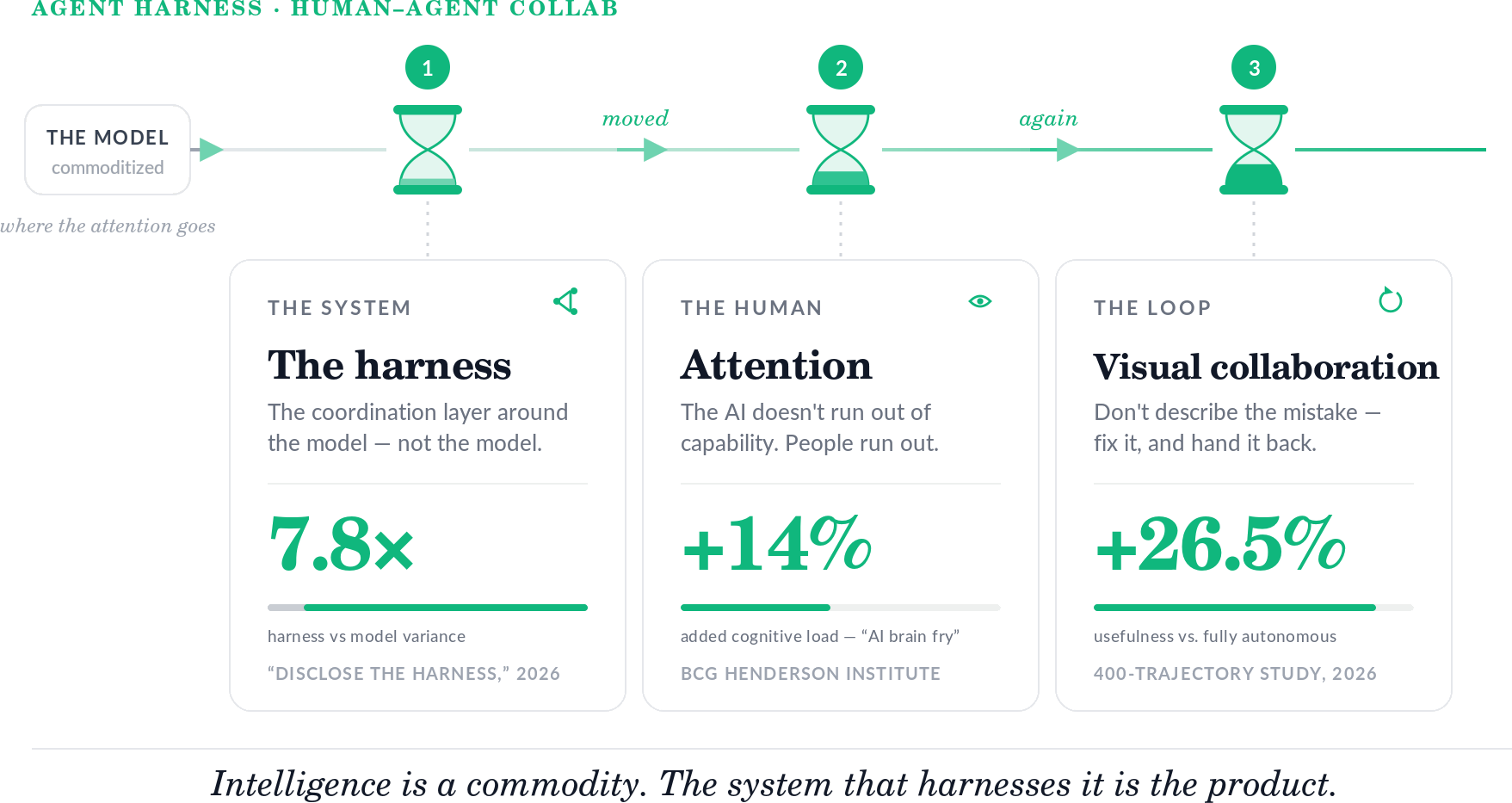
Something shifted in the last year, quietly and without most of the coverage noticing. The companies pulling ahead are not waiting on a smarter model. They are the ones who discovered that the bottleneck was never the model — and that since they fixed it, it has moved twice more.
The Diminishing Returns of Scaling.
For years, AI improved in a simple way: feed the model more data, give it more compute, and get a smarter output. Researchers call this "scaling."
But the people closest to this process are starting to say, carefully, that the automatic part is winding down. Dario Amodei, CEO of Anthropic, recently noted his surprise at how few people realize this scaling pattern is approaching its limits. Jensen Huang of NVIDIA has bluntly stated that the "free ride" of Moore's Law is over.
The more pointed argument comes from outside the labs. In a recent conversation with Lenny Rachitsky, market analyst Benedict Evans drew a precise historical parallel: mobile carriers invested approximately $200 billion annually building the 3G/4G/5G infrastructure that made the smartphone era possible. Their cumulative shareholder returns were near-zero. Apple and Google — the application and distribution layer above the infrastructure — captured all the value. Evans argues that AI model labs are structurally in the carrier position: essential infrastructure, no durable moat.
The engine that drove the last decade of AI progress is slowing. When it did, it revealed what was actually holding teams back — and it was never the engine.
Bottleneck One: The System
When you move from single-turn chats to autonomous agents navigating messy, real-world codebases, the paradigm breaks. A smarter model doesn't fix a broken architecture. What fixes it is a smarter agent harness — the coordination layer that surrounds the language model, manages state, interfaces with tools, and routes tasks.
The harness is not a minor variable. A 2026 paper — "Stop Comparing LLM Agents Without Disclosing the Harness" — ran a controlled experiment holding model weights constant while varying only the harness. Harness variance outweighed model variance by 7.80 to one.
What that ratio looks like in practice: the same Claude Sonnet 4.5 model scored anywhere from 34% to 68% depending on which harness ran it. With o4-mini, the swing reached 48 points. Independent benchmarking confirmed the same pattern — running identical model weights inside a sophisticated harness yielded 87.2% success compared to 61.5% in a basic environment, a 25-point swing documented by MindStudio. Inside the Scaffold — a source-code analysis of 13 real harnesses — maps why: tool counts range from 0 to 37 across harnesses, context strategies span 7 distinct approaches, and control loops range from fixed pipelines to tree search. The architecture space is enormous.
The model is not the variable. The harness is.
Fixing the system created the next problem: the output volume humans now needed to review.
Bottleneck Two: The Human
As AI increases the number of threads we can run at once, human attention becomes the limiting factor. Luke Alvoeiro's 16-day autonomous build experiment found exactly this: the bottleneck was not the AI running out of capability. It was the humans running out of attention.
For years, AI agents communicated via Markdown. It was cheap to generate and easy for machines to read. But as Thariq Shihipar from Anthropic's Claude Code team recently argued — in a post that became the basis for a Lenny's Newsletter episode — Markdown is a dead end for human-agent collaboration. Humans simply do not read 200-line Markdown files. A BCG Henderson Institute study found that high-oversight AI use required up to 14% more mental effort and predicted 19% greater information overload — a phenomenon they called "AI Brain Fry."
In the European market, human attention is not just a matter of UX; it is a strict regulatory and enterprise requirement. Enterprises cannot—and under frameworks like the EU AI Act, must not—deploy fully autonomous systems without robust human oversight.
The smartest teams are moving to HTML and interactive artifacts. Instead of handing a user a wall of text to review, the agent generates a living, interactive UI mockup. Visual, interactive formats allow humans to grasp system changes instantly without reading a single line of code, turning a cognitive bottleneck into a scalable governance mechanism. But well-structured output only solves half the feedback loop.
Bottleneck Three: The Loop
If interactive HTML solves the output problem, how do we solve the correction problem? The old model was "prompt, wait, review, correct." Every correction required describing the mistake in text — writing a new prompt to fix something you could see but could not touch.
Microsoft Research's Magentic-UI prototype shows what comes next. You can see what the agent is about to click before it clicks. You can take the keyboard at any point. When something goes wrong, the correction goes from "write a prompt describing the mistake" to "just fix it yourself and hand it back." Human and agent operate the same visual environment simultaneously — the feedback loop collapses from minutes to seconds.
This intervention-aware design is crucial for building enterprise trust. The value is measurable: a 2026 study of 400 real user trajectories found that intervention-aware agents — those designed for human takeover at any point — showed a 26.5% increase in user-rated usefulness compared to fully autonomous systems. By shifting from "prompt engineering" to "visual collaboration", technical roadblocks are turned into simple, visual, accountable decisions with a clear human-in-the-loop (HITL) audit trail.
You Do Not Monetize Raw Intelligence
For a long time, the AI industry was captivated by the pursuit of generalized intelligence. But the market has matured. Enterprises are no longer buying research visions — they are buying ROI, rapid time-to-market, and measurable productivity gains.
You do not monetize raw intelligence; you monetize reliable execution.
To move AI from an impressive prototyping tool to something enterprise teams completely trust with production work, the focus must shift away from the model itself. For product teams, the mandate is clear: Stop over-indexing on the model. Start architecting the harness, designing interactive artifacts, and collapsing the feedback loop.
There is no press release for a harness improving by 12 percent. No benchmark headline captures a 25-point swing from configuration choices alone. The advantage is invisible from outside, but it compounds every week. Intelligence is a commodity; the system that harnesses it is the product.